

Most people wake up exhausted without understanding why. Is sleep apnea silently running in their family? Research now shows that obstructive sleep apnea has a surprisingly strong genetic connection. Understanding genetics could change how people approach their health and their sleep.
What Is Obstructive Sleep Apnea?
Sleep apnea is a common sleep disorder that affects millions of people worldwide. It causes repeated interruptions in breathing during sleep throughout the night. These pauses can happen dozens of times per hour without the person ever knowing.
The most common form of this condition is obstructive sleep apnea. It happens when the muscles in the throat relax and collapse. This blocks the airway and temporarily stops normal breathing patterns.
The American Academy of Sleep Medicine recognizes obstructive sleep apnea as a serious public health concern. It is associated with heart disease, high blood pressure, and chronic daytime fatigue. A sleep medicine professional is often needed for an accurate diagnosis and treatment plan. Understanding the basics of the sleep cycle and what core sleep actually is helps put the severity of apnea-related sleep disruption into clearer perspective.
Is Sleep Apnea a Genetic Condition?
Many scientists have studied whether genetics plays a direct role in sleep apnea. The answer is yes, at least in part. Heritability estimates for obstructive sleep apnea in families sit at around 40%.
Studies confirm that first-degree relatives face an increased risk of developing the condition. This risk of developing sleep apnea persists even after adjusting for body weight. Genetic factors shape airway anatomy, obesity tendency, and how the brain controls breathing.
Sleep apnea and hereditary patterns share a growing and well-documented body of evidence. Twin studies and large genome-wide research have both confirmed this link. Variants like RMST/NEDD1 have been identified in the development of obstructive sleep apnea.
Causes of Sleep Apnea: Genetic Factors at Work
The causes of sleep apnea involve both genetic and lifestyle factors. Genetic factors influence the structure of the upper airway and how the muscles function. They also affect how the brain responds to drops in oxygen levels during sleep.
Genes linked to craniofacial structure can narrow the airway and raise the risk of blockage. FGFR mutations are known to cause syndromes like Apert and Crouzon. These conditions alter the anatomy of the throat and contribute to obstructive sleep apnea.
Obesity is a powerful risk factor for obstructive sleep apnea. Genes that drive fat storage can increase the risk of airway collapse over time. Obesity is also strongly tied to worsening apnea severity in those already affected.
Neural and serotonin pathway genes are also important. GPR83, DRD1, and HTR2A affect how the brain controls breathing during the night. TNF-alpha polymorphisms linked to inflammation can also increase the risk of airway problems.
Obstructive Sleep Apnea and the Role of Family History
Family history is one of the clearest risk factors for obstructive sleep apnea. First-degree relatives of OSA patients face roughly a 50% higher risk. This connection holds up across multiple population-level studies.
OSA is now recognized as a condition with a complex genetic architecture. Familial aggregation studies clearly confirm this hereditary pattern. The risk of developing obstructive sleep apnea in certain families is traced through multiple gene pathways.
Ancestry also shapes the genetic profile of sleep apnea. Research on obstructive sleep apnea in different populations reveals ancestry-specific markers. For example, 1p36.22 is linked to European Americans, while 15q26.1 appears more in African Americans.
Sex-specific variants are another important layer. Some markers, like 1q4, appear only in males. This points to how gender shapes the risk of obstructive sleep apnea across populations.
Central Sleep Apnea and Genetics: What Is the Difference?
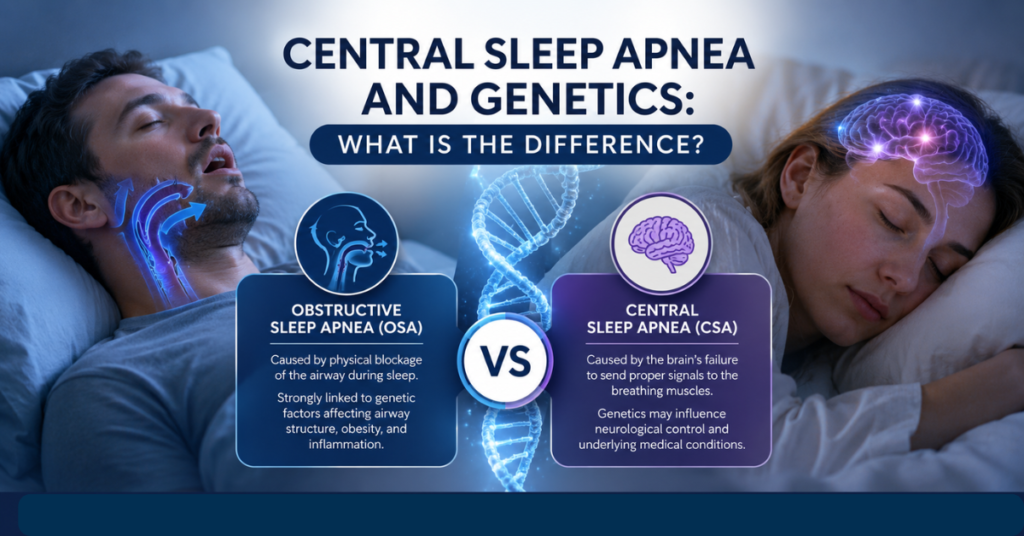
Central sleep apnea is a different type of sleep apnea with its own causes and patterns. It involves the brain failing to send correct signals to the muscles that control breathing. It is more closely tied to neurological conditions than to structural gene variants.
Unlike obstructive sleep apnoea, central sleep apnoea does not always involve a physical airway blockage. The genetic link with central sleep apnea is weaker than with the obstructive type. It is also less commonly diagnosed in the general population.
Complex sleep apnea refers to a mix of both central and obstructive features. Understanding and genetic distinctions between the two types is crucial for accurate treatment. Sleep medicine specialists rely on this difference to guide their clinical decisions.
Symptoms of Sleep Apnea to Recognize Early
Recognizing the symptoms of sleep apnea early can prevent serious long-term complications. Common signs include loud snoring, gasps at night, and headaches upon waking. Persistent daytime sleepiness is also a key warning sign to watch for.
In families with a known genetic risk, sleep apnea may appear before age 40. Sleep apnea may also present more severely when a hereditary pattern is involved. The condition can lead to serious cardiovascular and metabolic problems if left untreated.
Many cases remain undiagnosed because people do not realize they stop breathing during sleep. If someone you know snores heavily or wakes up often at night, encourage them to get screened. Early detection is one of the most effective tools available. It is also worth noting that breathing noise does not always stop when a person is awake. Understanding what causes snoring while awake can help identify whether the same airway issues are present even during waking hours.
If You Have Sleep Apnea Risk in the Family
If you have a close relative with obstructive sleep apnea, early action is very important. To have sleep apnea go undetected is to risk serious heart and kidney damage. A sleep study remains the most reliable diagnostic tool available today.
Certain genetic syndromes also raise the risk significantly. Conditions like Down syndrome, Apert syndrome, and Pierre Robin sequence alter craniofacial structure. Children with these conditions may have sleep apnea and persistent apnea even after a tonsillectomy.
If you notice ongoing fatigue or disrupted breathing at night, consulting a doctor is a smart move. Screening is especially important when there is a clear family history of obstructive sleep apnea. Early intervention can protect both sleep and heart health over the long term.
For Sleep Apnea: Treatment, Sleep Medicine, and Management Options
CPAP therapy remains the gold standard for sleep apnea and is widely recommended today. It keeps the airway open during sleep and reduces apnea episodes significantly. The American Academy of Sleep Medicine endorses it as the primary treatment approach.
Lifestyle changes also help manage the condition, and treatment options remain diverse. Weight loss of 10 to 15 percent can cut severe apnea risk by up to 50 percent. Side sleeping and using a humidifier can also help improve airway and breathing comfort.
Sleep medicine is now entering a new era of personalized care. Genetic insights may soon guide CPAP settings and melatonin therapy decisions. Variants like MTNR1B could help doctors tailor care to a patient’s unique genetic profile. Those who want to understand how restorative sleep works and what their body needs during treatment should read more about what is core sleep and why deep and REM stages matter so deeply to recovery.
And Genetic Testing: Is the Future of Sleep Apnea Care Personalized?
There is no routine genetic test for predicting general sleep apnea risk as of today. However, panels like Invitae, which cover 62 genes, are used in syndromic cases. And genetic research is advancing quickly through large-scale biobank studies worldwide.
Precision medicine is emerging as the next frontier in sleep care. Biobanks are enabling large-scale research into obstructive sleep apnea and its genetic roots. This science aims to create therapies matched to each patient’s genetic makeup.
Sleep apnea can be better understood as science continues to evolve rapidly. The combination of sleep medicine advances and deeper genetics research is highly promising. Understanding how a person’s unique genes influence their sleep could transform care entirely.

Stephanie is a dedicated content writer who loves crafting well-researched, reader-friendly articles. With a keen eye for detail and a knack for storytelling, she makes even the most nuanced subjects feel approachable and easy to understand.